Ten years without forgiveness: the killer of baby Alicia in Vitoria remains silent
A decade has passed since the murder of Alicia, aged 17 months, who was thrown from a window in Vitoria. Her mother, Gabriela, has received no apology from the convicted man.
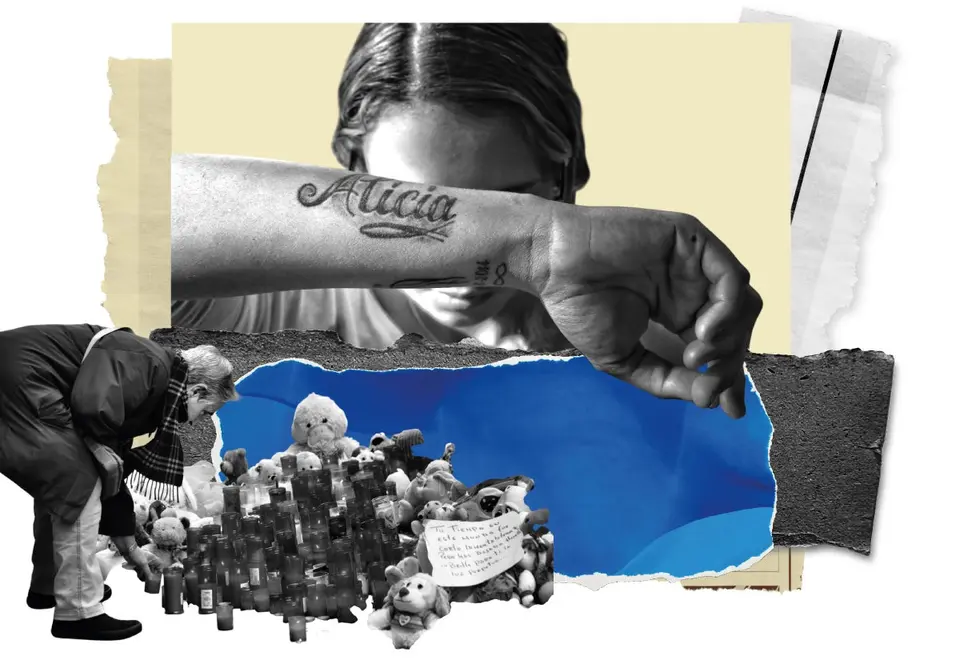
A decade without forgiveness for the murder of baby Alicia in Vitoria
In the early hours of 25 January 2016, Gabriela, a young woman from Burgos aged 19, watched her daughter Alicia, barely 17 months old, die in Vitoria. The person responsible was Daniel Montaño, a music teacher from Seville with whom she had begun a relationship through a dating website. According to Ideal, ten years after the crime, the condemned man has not addressed her at any moment to apologise.
Gabriela had travelled to the capital of Álava to visit Montaño, with whom she had spent the previous weekend in a rural house. He invited her to his flat on Calle Libertad. She accepted, but on the condition that she could bring her small daughter. Once in the apartment, Gabriela perceived strange behaviour in Montaño, who was already in his thirties, and decided to go to bed with the child intending to return to Burgos in the morning. He sent her a message on her mobile requesting oral sex. When he received no response, he burst into the room and began hitting her. He then threw the baby out of the window and tried to do the same to the mother, who resisted until calls from neighbours alerted the Ertzaintza.
Alicia died 48 hours later in hospital. Daniel Montaño was sentenced in autumn 2018, in a jury trial at the Provincial Court of Álava, to renewable life imprisonment—the first handed down in the Basque Country and the third in Spain. He will serve a minimum of 25 years behind bars. He is currently held in Sevilla 2 prison, in Morón de la Frontera. He will be able to access the third degree in some point in 2034 and conditional liberty on 19 January 2041.
This week, the family of the condemned man paid €100,000 of the €235,000 set as civil liability for Gabriela—of Brazilian origin—and for Carlos, the father of the child. This is the second payment of that amount, following an identical transfer in February of last year. According to Ideal, the prosecutions refuse to allow these payments to affect the granting of early penitentiary benefits.
Gabriela now lives in the province of Soria. "I still find it very difficult to sleep," she says. "I try to look forward, but these dates make things a bit harder for me." After the crime, she received numerous criticisms on social media for having taken her daughter to Vitoria, which made her, in her own words, a double victim. She left Burgos and took refuge in Hontoria del Pinar, the village near Soria where she grew up and where she met Alicia's father. Recently she moved again to another place where nobody knows her story.
Regarding the lack of contact with her attacker, Gabriela is forthright: "He has not apologised to me, not at any moment. But I tell you today that it is irrelevant to me. The less I know about him, the better." Remorse is, in principle, one of the conditions that courts value when improving the penitentiary situation of an inmate.
The conviction does not seem sufficient in her eyes. "It seems little to me, but it is what there is and I will have to live with it," she states. Renewable life imprisonment, approved one year before the crime, has been applied in some fifty cases since then. Among the most well-known is that of Ana Julia Quezada, convicted for the murder of the child Gabriel Ruiz.
The trial left a profound mark on those who participated. Daniel Montaño stated that he had seen "the devil" in Gabriela and "his son" in little Alicia, and claimed that "both wanted to end the world" and that he "had to prevent it by killing them". His questioning lasted three hours. After the questions from prosecution and defence, judge Jesús Poncela put a single question to him: "What has happened to the end of the world?". The accused hesitated and could barely articulate a coherent response. That moment was considered by those present as the turning point of the proceedings.
The defence alleged paranoid schizophrenia with psychotic episode. However, of the ten psychiatrists who intervened as expert witnesses, only the two appointed by the defence upheld that diagnosis. Judge Poncela himself noted an element he considered decisive: "Half an hour before the assault, he sent her a WhatsApp message asking her to perform oral sex. It is difficult to think that a person who supposedly has apocalyptic ideas, with the struggle between good and evil, would take a break in his delusion to ask for oral sex".
The prosecutor who requested renewable life imprisonment explained his decision with precision: "The fact was so serious that my hand did not tremble when I requested it". For his part, the lawyer for the popular prosecution highlighted the effort to make the expert reports understandable to the jury: "We explained the reports as simply as possible so that no exemption would be applied to him". Judge Poncela added another detail that remained etched in his memory: "I will never forget when, during the trial, my client saw for the first time and embraced the Ertzaina who looked after the child".
In the six months before the crime, Montaño had gone to the doctor on three occasions.
Source: Ideal