Uncertain Future of UCO Anti-Corruption Chief Following Promotion to Colonel
Interior Ministry must decide whether Lieutenant Colonel Balas continues to lead the Koldo case following his promotion. Judge Moreno and the Public Prosecutor's Office call for his continuity at the UCO.
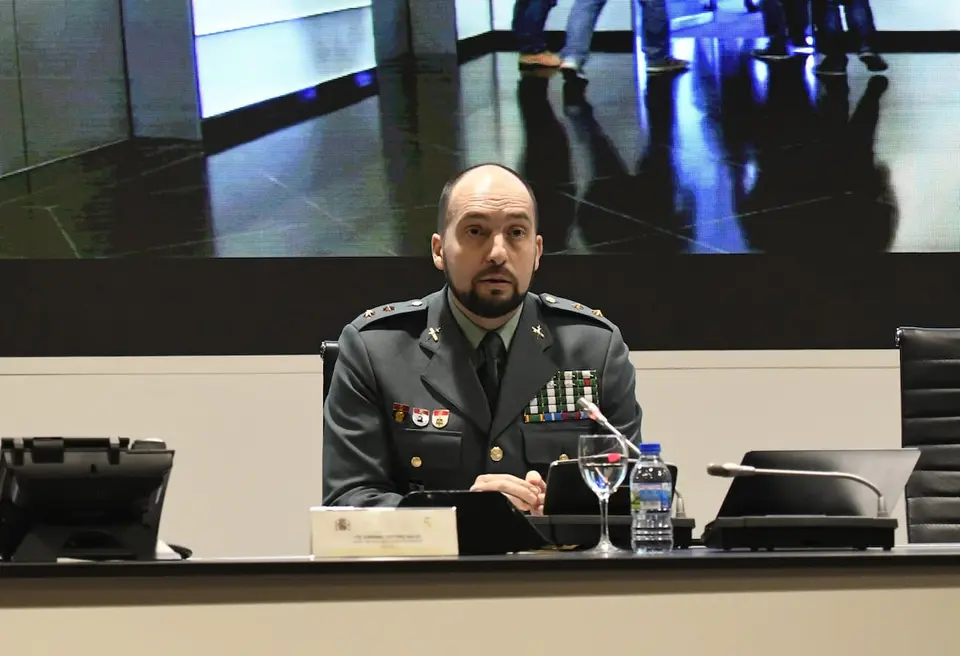
Interior Ministry Weighs How to Keep UCO Anti-Corruption Chief Following Promotion
The Interior Ministry faces a significant decision: determining the future of Lieutenant Colonel Antonio Balas, head of the anti-corruption department at the Central Operational Unit (UCO) of the Civil Guard. According to El País, his promotion to colonel—whose publication in the Defence Ministry's Official Bulletin is imminent—would, in principle, result in his departure from the unit and the abandonment of the investigations he leads.
The promotion was planned in advance: Balas occupies the sixth position in the lieutenant colonel ranks to whom promotion to colonel rank corresponded as of 1 July. However, the timing of this promotion complicates the decision. His advancement comes barely two months after an investigation he led resulted in the indictment of the Civil Guard's Director General, Mercedes González, and her deputy, Lieutenant General Manuel Llamas, for alleged pressure on the unit to obstruct enquiries affecting the PSOE and the family circle of President Pedro Sánchez.
Judge Moreno's Request, a Determining Factor
National Court Judge Ismael Moreno and the prosecutor in the Koldo case, Luis Pastor, have formally requested that Balas remain at the head of the Koldo case investigations—which examines an alleged corruption scheme within the Transport Ministry during the tenure of former minister José Luis Ábalos—. In their written submissions, the magistrate emphasised that the anti-corruption department requested that the officer remain in his position "for the time necessary" to conclude the enquiries, given his "significant role" in investigating the alleged irregularities of Ábalos and his former adviser Koldo García.
Sources at the armed forces consulted by El País consider that this request makes it almost inevitable that Balas will continue at the UCO for a period, at least, given the language employed by the judge and prosecutor in their written submissions.
The Service Commission Route
From an administrative perspective, the most straightforward solution would be to keep Balas in place through a service commission, a mechanism that allows temporarily assigning an officer to a post different from that corresponding to their rank. The Civil Guard has already resorted to this procedure in recent months with two other lieutenant colonels at the UCO—heading the cyber-crime and drug-trafficking departments—who remained in their posts for months despite being promoted to colonel. Service commissions have a maximum duration of one year, although they can be extended in exceptional cases.
Judge Moreno's request must, however, clear several internal procedures. Colonel Pedro Merino, head of the UCO, must issue a report on the advisability of the officer's continuity and submit it to the Judicial Police Directorate. The latter must, in turn, issue its own report. The head of that directorate is General Alfonso López Malo, former head of the UCO whose testimony as a witness in the Leire Díez case reinforced evidence of alleged pressure received by unit officers. In similar cases, this double procedure typically resolves favourably. The final decision, however, rests with the General Staff, which directs personnel policy at the institute. "Many service commissions are granted each year," notes one of the sources consulted, who takes it for granted that one will also be granted to Balas.
Two Possible Scenarios for Department Structure
The Civil Guard faces two options. The first is to keep Balas at the head of the anti-corruption department without calling a competition to fill the vacancy he would leave, so that he would continue leading all ongoing investigations and those that might arise during the service commission.
The second option consists of limiting his continuity to investigations for which judges have formally requested his presence. So far, only the request from the magistrate in the Koldo case has come to light, but Balas also heads enquiries into the Leire Díez case—under the direction of National Court Judge Santiago Pedraz—and one being conducted by a Madrid judge into Alberto González Amador, partner of Madrid's regional president Isabel Díaz Ayuso, among others.
In that scenario, the Civil Guard would call a competition to fill the department's headship, and the new commander would assume the remaining investigations and those arising thereafter. The result would be the coexistence of two heads for the same department, a situation that, in the view of the sources consulted, could generate internal tensions. These same sources note that certain lieutenant colonels have already been sounded out to ascertain whether they would be willing to put themselves forward as candidates in the event the post were offered, with none having shown interest so far.
The Video That Put Him in the Spotlight
Balas gained public prominence in May of last year, when a recording emerged in which former socialist activist Leire Díez and businessman Javier Pérez Dolset attempted to convince Basque businessman Alejandro Hamlyn—under investigation by the Civil Guard—to provide them with compromising information about the lieutenant colonel. In that recording, Díez could be heard stating: "If Balas is dead, better."
Source: El País