Mafias charge up to €9,000 to migrants in Ceuta for crossing to the mainland by speedboat
Police arrest five people from two criminal networks who exploited the mass arrival in Ceuta to traffic migrants in unsafe boats.
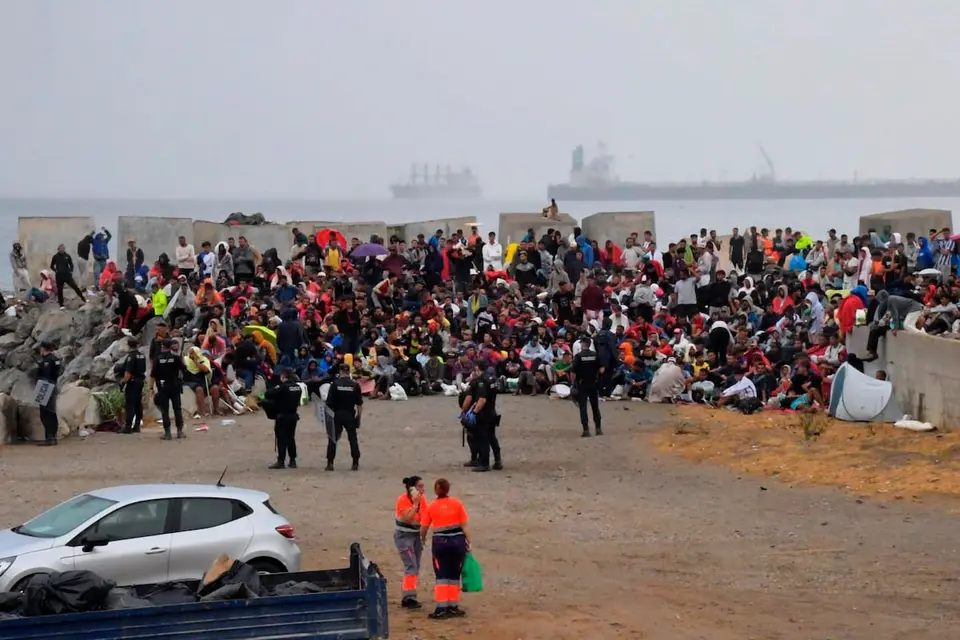
Five arrested for charging up to €9,000 to migrants to cross the Strait from Ceuta
The National Police have dismantled two criminal networks that charged up to €9,000 to migrants in irregular situations to transport them clandestinely from Ceuta to the Andalusian coasts in small boats, at night, crammed together and without life jackets. This was reported by the Interior Ministry on Friday, according to El País.
The five alleged members of both organisations were arrested in recent days by officers of the Immigration Brigade. Four of them—two arrested in Ceuta and two others in La Línea de la Concepción (Cádiz)—are Spanish nationals and face charges of criminal organisation and facilitation of irregular immigration. The fifth detainee has been remanded in custody after transporting seven people in a five-metre-long boat that ran out of fuel mid-Strait on the night of 14 August.
The goldmine of the mass arrival
The networks took advantage of the arrival of more than 80,000 people swimming to Ceuta on 30 and 31 July to intensify their activity. The latest official estimates put at 5,000 the migrants still remaining in the autonomous city, although other sources double that figure. Of those remaining, more than 2,000 are minors.
Police sources consulted by El País explain the price increase with market logic: "There is more demand and the mafias have raised their prices." The amount, already high before the crisis, has reached €9,000 per person in recent weeks, a price higher than usual according to sources close to the investigation.
The first organisation: fast boats from La Línea
The investigation of the first network began on 13 August, when police located a "speedboat"—a vessel with one or two outboard motors—stranded on a rocky outcrop in the coastal area of Benzú, next to the El Tarajal spit, the scene of the mass arrival. Analysis of the hull revealed marks and damage consistent with high-speed navigation, compatible with recent use for the transport of people.
The organisation, which has been operating for some time between Morocco, Ceuta and La Línea de la Concepción, had recruiters in the autonomous city tasked with recruiting migrants willing to pay. Once they accepted, they were transferred to homes, garages and other properties controlled by the network, where they waited until being driven to coastal embarkation points, usually harsh areas such as Calamocarro. To avoid police controls—which have been heavily reinforced in recent weeks—members of the group took precautions in each movement.
The boats departed from the Cádiz coast, picked up migrants in Ceuta and took them directly to the mainland, where other members of the network waited for them to disperse them on land. The boat pilots were hired for "substantial" sums of money and had experience in "fast navigation" and in "carrying out evasive manoeuvres and evading police controls," according to the National Police in their official statement.
The second investigation: five hours adrift in the fog
The second operation was launched in the early hours of 14 August, when seven people arrived at El Burgo beach, near La Línea de la Concepción, on board a small boat in extreme conditions. According to accounts given by the occupants to officers, they had departed before midnight and spent nearly five hours on a sea covered by dense fog, with intense cold and clothing soaked by waves entering the vessel.
Each of the seven had paid €8,000 for the journey. The crossing worsened when the boat drifted after running out of fuel. None of the passengers wore life jackets, and almost none could swim.
The sole detainee in relation to this case is accused of an offence against the rights of foreign citizens, aggravated by profit motive, the special vulnerability of the victims and the danger to their lives. The judge has remanded him in custody.
A business built on the risk of others
The journeys described in both investigations have in common the disproportion between the price demanded and the conditions offered: hours of night-time navigation in shallow-draft vessels, without safety equipment and exposed to Strait conditions. The networks, according to police sources, increased their tariffs precisely when the number of potential clients—migrants in irregular situations stranded in Ceuta—reached its peak following the mass arrival in late July.
Source: El País