Mafias transport foldable boats from mainland to Ceuta to evade controls
National Police detect that criminal networks are moving inflatable boats from the mainland to operate in Ceuta, charging up to 10,000 euros per crossing of the Strait.
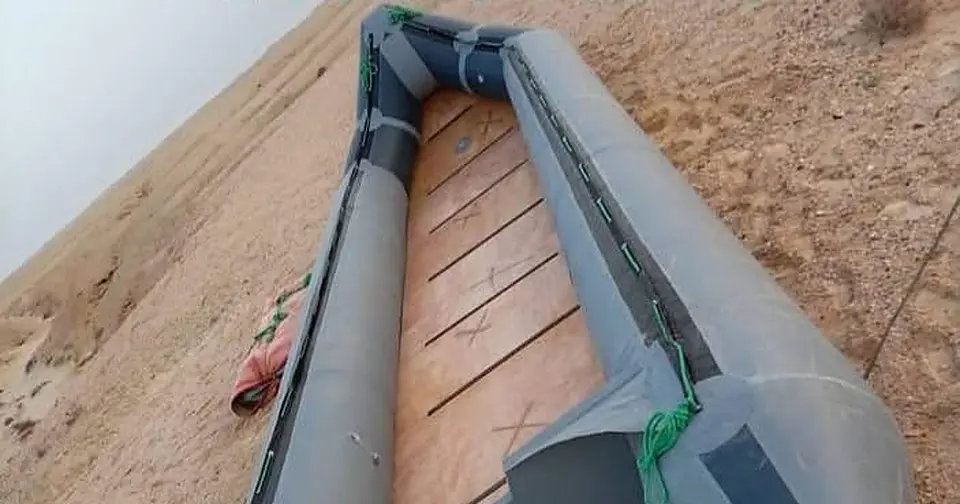
Foldable boats and dual business: the new modus operandi of mafias in Ceuta
Police sources have informed ABC that the National Police have detected that criminal organisations are bringing folded boats from the mainland into Ceuta with the aim of increasing the number of clandestine transfers of migrants to the continent. Police pressure in recent weeks—with several members of these networks already arrested—is accelerating the movement of the mafias, which see threatened the profits derived from crossing the Strait of Gibraltar.
The starting point of this upsurge was the surge recorded in Ceuta on 30 and 31 July. That episode generated a wide pool of potential customers for organisations dedicated to human trafficking: both those who remain in the autonomous city and those who returned to their countries of origin after discovering that entry into the European Union was more difficult than expected.
Prices between 8,000 and 10,000 euros per person
Specialists from the National Police's Central Unit of Illegal Immigration Networks and Document Forgery (Ucrif) have ongoing investigations against these groups. According to the same sources, the organisations charge between 8,000 and 10,000 euros per person to carry out the crossing.
The reason mafias resort to boats coming from the mainland is the surveillance that falls on boats registered in Ceuta. The regular boats in the autonomous city are registered in the names of local residents and are subject to constant monitoring by the State Security Forces and Bodies, according to police sources cited by ABC.
Boats that arrive folded and are inflated on the beach
Investigators have confirmed that the ships themselves that arrive from the mainland to participate in the transfers carry folded boats on board. Once in Ceuta, these boats are unloaded and inflated directly at departure points. Among the identified locations are Benzú, the rocky area of Santa Catalina, Punta Almina, the Potabilizadora beach and the Sarchal, enclaves which by their topography and accesses facilitate this type of operation.
Once deployed, the boats receive wooden boards or structures on the lower part to provide them with greater rigidity, and a low-power outboard motor is installed. The assembly—boat and motor—can be manipulated and transported by a single person.
A parallel business: buy for 1,000 euros, sell for 6,000
The mafias also exploit a lucrative secondary market with this material. Foldable boats are purchased on the mainland for around 1,000 euros and are resold in Ceuta at prices that can reach 6,000 euros. By transporting them folded, they prevent them from being intercepted at the entry controls to the autonomous city, where they would be easily detectable if moved as conventional boats.
This system provides the networks with a dual advantage: having material in different points of the coast quickly and minimising the chances of detection before the boats are operational.
Two networks dismantled and five arrested
Both the National Police and the Civil Guard have been working for weeks to dismantle these organisations. Last Friday the dismantling of two groups dedicated to illicit human trafficking from Ceuta to the mainland across the Strait was announced. Five people were arrested under two parallel investigations conducted in the autonomous city and in La Línea de la Concepción.
Those involved used small boats to clandestinely transfer migrants from Ceuta territory to peninsular coasts. The National Police has warned that this practice places passengers "in serious danger". In one of the documented routes, seven people remained crammed for five hours in a five-metre boat with two-metre beam, without fuel and without any safety element such as life jackets.
The amounts demanded for these transfers could reach 9,000 euros per occupant. A witness has confirmed to the authorities that in a single crossing 56,000 euros were raised in total.
The Unified Police Union calls for more resources
The Unified Police Union (SUP) describes an increasingly "worrying scenario" in Ceuta. In statements collected by ABC, union sources warn of "perfectly organised mafias that continuously adapt their methods to evade police action and obtain significant profits from human trafficking".
The SUP calls for reinforcing investigation, intelligence and controls over the logistic and economic networks that make these transfers possible. "It is not enough to act when the boat is already at sea: you must anticipate, identify those who organise, finance and facilitate these operations and put all necessary resources into dismantling these networks before they can put more lives at risk", they point out.
Source: ABC