Drug trafficking on the Guadalquivir: more than 11 tonnes of cocaine seized since 2022
The Guadalquivir river has become one of the main routes for drug smuggling into Spain, with narco-speedboats transporting cocaine towards Europe. Since 2022, the Guardia Civil has arrested around 750 people and seized more than 88 tonnes of hashish.
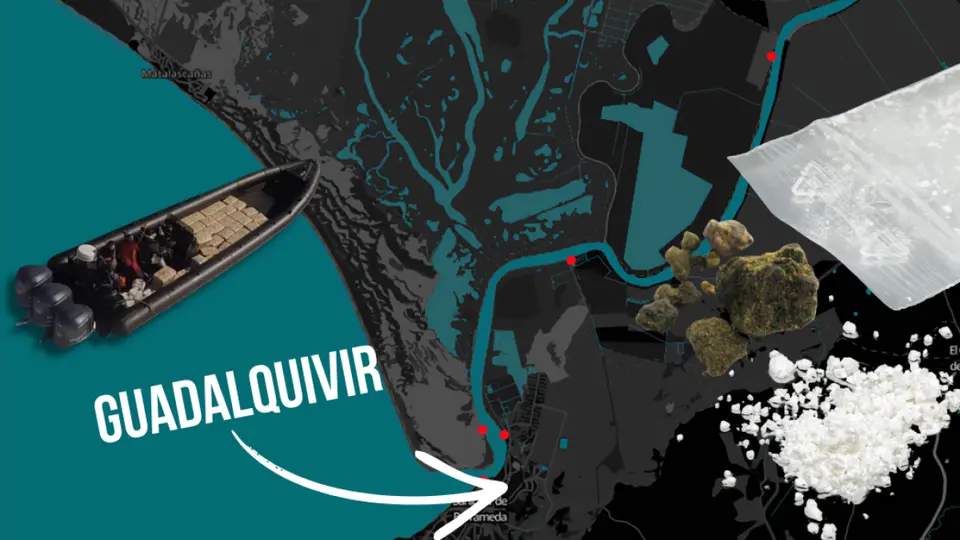
The Guadalquivir, new cocaine route towards Europe
Since 2022, the Guadalquivir river has established itself as one of the main drug-smuggling routes into the Iberian peninsula, according to a written statement from the Guardia Civil to La Vanguardia. Between that year and 2024 there was "a significant increase in drug-trafficking activity" on the river, turning it into a key gateway for the trafficking of narcotics destined for the rest of Europe.
Since then, more than 200 police operations have made it possible to seize more than 88 tonnes of hashish and more than 11 tonnes of cocaine. During the same period, around 750 people have been arrested, nearly 135,000 litres of fuel have been seized, and almost 50 vessels have been confiscated, according to data provided by the Guardia Civil to the aforementioned newspaper.
Mobile barriers and permanent patrols
Following the deaths of two civil guards in Huelva in early May, Interior Minister Fernando Grande-Marlaska announced to the Senate the construction of "mobile barriers" on the Guadalquivir to stop narco-speedboats from passing through. Between three and four naval units of the force operate permanently at the mouth of the river.
The Guardia Civil allowed La Vanguardia to board the 'Río Guadalmedina', an interceptor vessel based at the port of Chipiona, a municipality situated at the mouth of the river. The departure, scheduled for 10:00 in the morning, was delayed by an hour and a half due to an operation carried out during the early hours, with the force providing no further details. "There are patrol boats every day," said one of the commanders in charge of the vessel.
Narco-speedboats abandoned on the shore
During the patrol, the vessel reduced speed to approximately one hundred metres before the Torre arm—a branch of the river too narrow for the interceptor to access—and approached the shore. There lay two abandoned narco-speedboats, separated by barely fifty metres from each other, both without engines.
Drug traffickers systematically remove the engines from the vessels before fleeing: they are the most valuable part and the most reusable. The presence of speedboats abandoned or concealed on the banks of the Guadalquivir is not exceptional. Through satellite imagery obtained using the World Imagery Wayback tool and verified by a police source, La Vanguardia identified five narco-speedboats on the shore of the lower course of the river—south of Isla Mayor—on the same date the boarding took place.
Residents of Chipiona also corroborate their presence. José Julio Lorenzo Mellado, a local businessman, describes it thus: "When I go out to do sport fishing, I usually see one. They go very fast and head towards the mouth of the river, and they go in."
A change of route for cocaine
The trafficking of hashish from Morocco on the Guadalquivir is not new, although previously it was concentrated in the Campo de Gibraltar. The launch of the Special Security Plan for that zone in 2018 displaced the activity to other points in the province. "What has happened has been to contaminate other places in the province, and fundamentally the Guadalquivir," explains Francisco Mena, president of the anti-drug co-ordinator Alternativas en Andalucía and a key social interlocutor in the implementation of that plan.
The most significant shift, however, is the emergence of cocaine. "It is not the natural medium for cocaine," admits a member of Spain's State Security and Police Forces specialised in drug-trafficking routes, who speaks anonymously for security reasons. This substance usually reaches Europe via containers in major ports such as Valencia, Barcelona or Algeciras.
Europol and the Anti-Drug Prosecutor's Office point to the Cádiz-Seville axis
A Europol report from January 2026 highlights the role of the Guadalquivir in the maritime trafficking of cocaine towards Europe. The latest report from the Anti-Drug Prosecutor's Office (2025) points in the same direction, referring to "a new route of entry for this drug on the Cádiz-Seville axis destined for the rest of Europe". Between December 2024 and January 2025, 10 tonnes of cocaine were seized in barely two weeks in areas bordering the river, including a seizure in Coria del Río of 6,500 kilogrammes.
The cocaine circulating on the Guadalquivir comes mainly from Peru, Colombia and Bolivia. It arrives at Spanish coasts aboard mother ships or, in other cases, is unloaded further south in Africa—for example in Senegal—, is transported by land to Moroccan beaches and from there follows the same routes as hashish. Despite police pressure, the Guardia Civil notes that "during 2025 drug-trafficking activity on the river has declined significantly compared to previous years".
Source: La Vanguardia