Six years without Rosalía: family urges UCO to reopen investigation
A 74-year-old woman disappeared in Bohonal de Ibor on 25 May 2020 and has not been found. Her children are calling for UCO intervention to advance a shelved case.
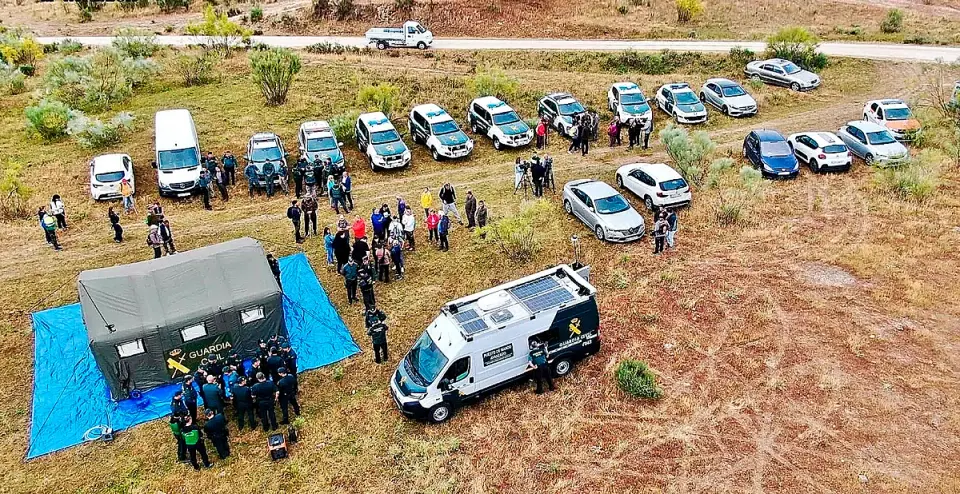
No trace since May 2020: Rosalía's family demands a new investigation
On 25 May 2020, in the midst of the pandemic, Rosalía Cáceres went for a walk around Bohonal de Ibor, a town in Cáceres province with around 500 inhabitants. She was 74 years old, knew the area well and regularly walked alone in the surrounding countryside. She never returned. Six years later, the case remains unsolved and the judicial summary remains provisionally shelved, according to El Mundo.
Salvador Serrano, a family spokesperson, draws a direct comparison: "There is a clear similarity between the cases of Manuela Chavero, Francisca Cadenas and Rosalía Cáceres." Chavero and Cadenas, also disappeared in rural areas of Extremadura, were found murdered years after the Central Operational Unit (UCO) of the Guardia Civil took over their respective investigations. Rosalía's case, meanwhile, remains at a standstill.
The last call: "I'm cooling my feet, I'll be back soon"
That morning, Rosalía set out around 8.00 am, as was her habit. Before leaving, she had informed her daughters that she planned to take a longer route than usual, convinced that Covid restrictions had caused her to gain some weight. She measured 1.55 metres and weighed 50 kilogrammes.
During the walk she maintained several telephone conversations. The last two were with her cousin and her son Enrique. It was almost midday and both insisted that she return home. She replied from El Pibor, a little-frequented location in the surroundings of the Tajo river, usually visited by hunters: "I'm cooling my feet, I'll be back soon." It was 13.55 hours. This was the last sign of life. From that moment on, she did not answer any calls. That same afternoon the first neighbourhood searches began. They yielded no results.
Rosalía was a regular resident of Madrid. The state of alarm decree had caught her on a visit to Bohonal de Ibor, the birthplace of her husband, who died in 2012, and home to several generations of her family. Her five children decided it was better for her to spend the pandemic in the village rather than confined to her flat in the capital.
Searches with no results and case shelved
The Guardia Civil found no "signs of criminality" in the case. The official hypothesis points to an accident following a possible loss of way in a rugged four-kilometre area with rocks, steep paths and historical dolmens in the Campo Arañuelo region. Other hypotheses are not completely ruled out, but the summary remains provisionally shelved.
On 8 May a new search operation was carried out with an extensive deployment: drones, a specialist dog unit trained in search and rescue, Seprona agents on motorcycles, the Citizen Security Unit of the Cáceres Command, the Special Mountain Rescue and Intervention Group and an Advanced Command Post with satellite connections. No trace was found, neither of the body, nor of her clothing, nor of her mobile phone. Over these six years, the location—including the nearby reservoir—has been inspected on numerous occasions. The result has always been the same: nothing.
"We do not understand how cases can be treated as first or second priority"
The family rejects the lost-person hypothesis. "She knew the terrain perfectly and even the three gates of the fenced area where she was," says Rosalía's son-in-law, who also rules out sudden illness: "She was a very vital woman, she was healthy." For those close to her, the possibility that a third party was involved cannot be excluded. "For us there is clearly the possibility that third parties could have been involved, someone she might have met on her way back, who knows, but it has to be investigated," says the son-in-law.
Family spokesperson Salvador Serrano acknowledges "helplessness and a sense of abandonment", although he clarifies that the criticism is not directed at the officers who have worked on the case: "But we do not understand how cases can be treated as first or second priority; we do not know whether special teams were deployed in this case because of the public alarm at that time and not in other cases." During the investigation, four or five people were questioned, all with alibis, but the family believes those alibis "have not been sufficiently verified."
The family calls for UCO involvement
The central request of the children and son-in-law is that the UCO take over the investigation. "We want to have an opportunity, to know what happened, and that is why we are asking for a change in the investigation, for other officers to arrive, whether from the UCO or elsewhere, so they can have another perspective on the case," says Serrano.
The parallel with the Chavero and Cadenas cases reinforces this argument: in both, the entry of the UCO proved decisive in clarifying the whereabouts of the victims, who were found murdered. "This case has much to do with the other two women who disappeared in Extremadura in recent years," the son-in-law emphasises. The family concludes with a position it describes as free from any institutional confrontation: "We are not against anyone, but we want solutions."
Source: El Mundo