Human rights lawyer files complaint with IACHR against prosecutor Barros over linking social unrest to organised crime
Human rights lawyer Karinna Fernández filed a formal submission with the Inter-American Commission on Human Rights (IACHR) challenging statements made by prosecutor Héctor Barros linking the 2019 social unrest to organised crime.
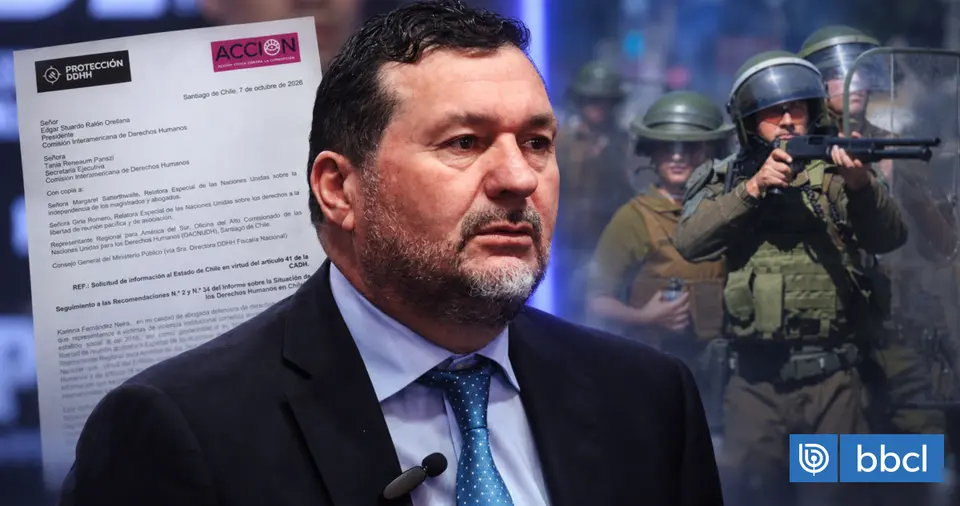
Prosecutor Barros denounced before IACHR over statements on unrest and crime
Human rights lawyer Karinna Fernández submitted a formal communication to the Inter-American Commission on Human Rights (IACHR) in response to statements made by Héctor Barros, regional prosecutor for Metropolitan South, who linked the 2019 social unrest to weakened police operations and the subsequent expansion of transnational organised crime in Chile. According to biobiochile.cl, the action seeks to have the international body request explanations from the Chilean state.
The controversy erupted following an interview in which Barros—who is serving out his final months in office—established a direct link between the October 2019 protests and the rise of transnational crime.
"There is something that remained from the social unrest; it produced many changes; after the unrest, transnational crime appeared. In the case of each action Carabineros took, it was seen as a violation of fundamental guarantees. That produced a certain reluctance to use the guarantees they have," the prosecutor stated.
In the same interview, Barros argued that public criticism of Carabineros during the protests generated a kind of inhibition among uniformed officers in exercising their powers. According to his explanation, officers felt that any procedure could be subject to scrutiny, regardless of how they acted.
"If they did something they would be judged, if they didn't do it, they would also be judged publicly. All eyes were on that conduct," he asserted.
The prosecutor added that some carabineros may have opted to avoid procedures rather than risk facing administrative responsibilities that could damage their careers. For Barros, that concern would have ultimately affected the way police today tackle crime.
"Someone at some point is going to analyse it from the perspective of crime; the way they were judged publicly has made Carabineros not act taking all the precautions it has to take," he affirmed.
Fernández's response and the IACHR action
Lawyer Karinna Fernández, who has represented victims of police violence during the unrest, rejected Barros's statements and described them as "callous and unfounded expressions from the prosecuting authority".
In her submission to the IACHR, Fernández questions whether the prosecutor establishes a link between scrutiny of police conduct and the advance of organised crime without concrete evidence to support it. Furthermore, she warns that those words cast doubt on the impartiality of investigations into police violence conducted under Barros's direction in the Metropolitan South Prosecutor's Office since 2019.
"The callous and unfounded expressions from the prosecuting authority not only put at risk the victims of police violence yesterday and today, but guarantee the repetition of such crimes," the legal expert said.
For Fernández, Barros's statements show that victims "never had access to impartial prosecution", which, according to her interpretation, enables international forums "to prosecute those responsible individually".
The lawyer also pointed to the silence of the national prosecutor, Ángela Valencia, regarding Barros's statements, and framed it within what she described as "a structure of impunity seven years after the events".
"The various obstacles to investigations, including that of high command, the evidence of violent bias by a regional prosecutor and the silence of the national prosecutor, followed by discourse supporting pardons for those responsible for serious human rights violations, are making it clear: that we can prosecute those responsible in the international forum," she affirmed.
What the submission to the IACHR seeks
With the formal communication, Fernández seeks to have the IACHR require the Chilean state to provide a series of concrete evidence. Among other things, she requests to know what studies support the link Barros established between the social unrest, police inhibition and organised crime, and whether that interpretation corresponds to a personal opinion of the prosecutor or to an institutional position of the Public Ministry.
She also requests that the results of investigations into police violence processed in the Metropolitan South Prosecutor's Office be made transparent, and that consideration be given to reviewing archived cases and decisions not to proceed.
Barros's statements come just days before the seventh anniversary of 18 October 2019, the date that marked the beginning of the social unrest that left hundreds of victims of police violence and multiple pending legal cases.
Source: Google News CL — Crime